- Produced by The Royal Mint.
- 1953 was the only year in which this version of the Five Shillings coin was released, commemorating the start of the reign for Queen Elizabeth II, after officially ascending to the throne on 6th February 1952.
- The coin was specifically created and released to commemorate the coronation of Queen Elizabeth II, which took place at Westminster Abbey in London on 2nd June 1953.
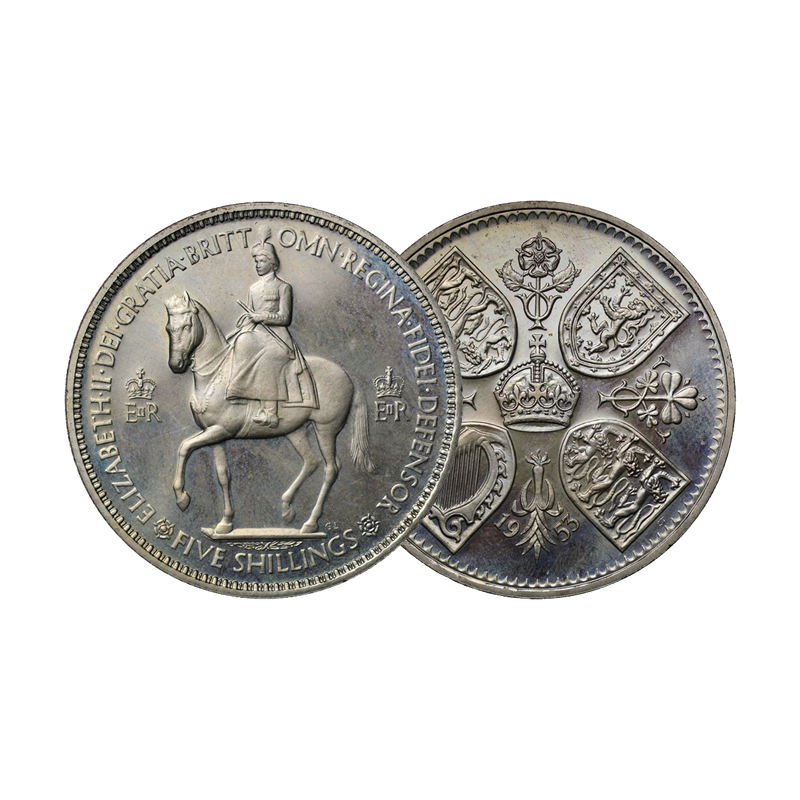
- The reverse of the coin shows the 'Cruciform Shields', design, representing the four constituent parts of the United Kingdom, a design by Edgar Fuller which was modelled and engraved by Cecil Walter Thomas OBE.
- The shields on the reverse of the coin feature the Passant Guardant Lions of England, a floral bordered Lion Rampant of Scotland and the Harp of Ireland.
- The four shields featured on the reverse of the coin form a diagonal cross around an illustration of the heraldic 'Tudor Crown', design.
- The heraldic 'Tudor Crown', design, also known as the 'Imperial Crown', design, is prominently illustrated in the centre of the design, on the reverse of the coin.
- The Tudor Crown was a crown created in the early 16th century for either King Henry VII or King Henry VIII, the first Tudor monarchs of England. The crown was destroyed in 1649 during the English Civil War.
- There are four floral symbols on the reverse of the coin, a rose for England, shamrock for Northern Ireland, leek for Wales and thistle for Scotland, which are illustrated between the shields of the United Kingdom.
- The initials 'EF', of the artist who reimagined the 'Cruciform Shields', design, Edgar Fuller, are located below the bottom left shield, featuring the Harp of Ireland, on the reverse of the coin.
- The initials 'CT', of the artist who modelled and engraved the reimagined 'Cruciform Shields', design, Cecil Walter Thomas OBE, are located below the bottom right shield, featuring the Passant Guardant Lions of England, on the reverse of the coin.
- The year '1953', is shown on the reverse of the coin, divided at either side of the Welsh Leek, which is featured on the bottom of the design.
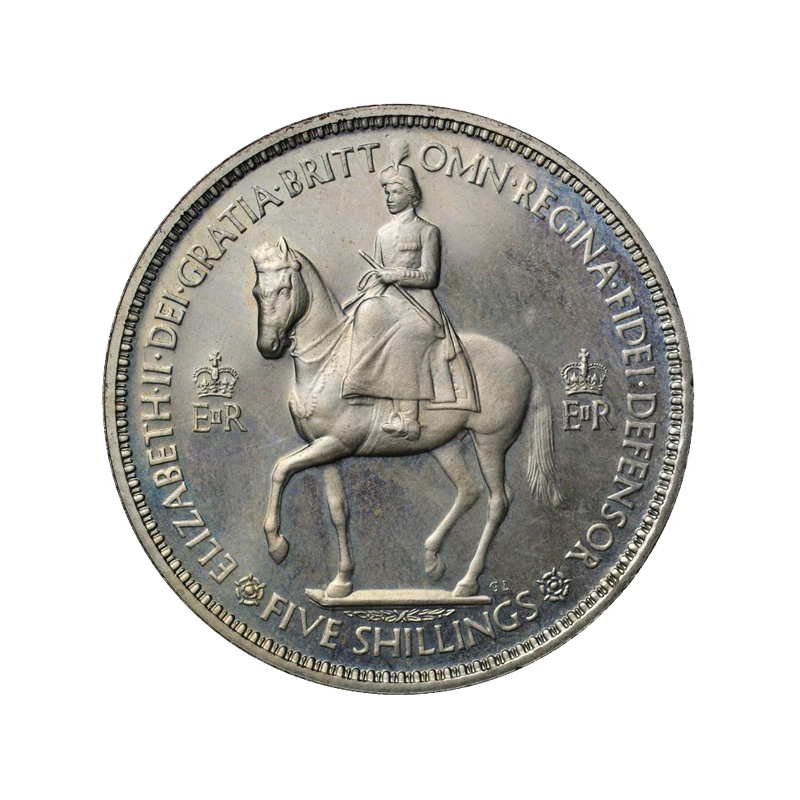
- The obverse of the coin features the equestrian portrait, which shows Queen Elizabeth II on horseback advancing left.
- The crowned Royal Cypher of Queen Elizabeth II is featured at either side of the equestrian portrait, on the obverse of the coin.
- The Royal Cypher of Queen Elizabeth II, 'E II R', is an abbreviation of the Latin 'Elizabeth II Regina', which translates to 'Elizabeth the Second, Queen', in English.
- The heraldic design of the 'St. Edward's Crown', is featured above the Royal Cypher of Queen Elizabeth II that appears on the obverse of the coin.
- St. Edward's Crown was originally a medieval crown dating back to the 11th century.
- Associated with St. Edward the Confessor, the replacement crown has been used to crown British monarchs at their coronations since the 16th century and resembles the original medieval crown that was melted down in 1649.
- The Latin inscription around the obverse of the coin, 'ELIZABETH · II · DEI · GRATIA · BRITT OMN · REGINA · FIDEI · DEFENSOR', an abbreviation of 'ELIZABETH II DEI GRATIA BRITANNIARUM OMNIUM REGINA FIDEI DEFENSOR', translates as 'Elizabeth the Second, by the grace of God, Queen of all the Britains, Defender of the Faith', in English.
- The inscription for the denomination of 'FIVE SHILLINGS', is shown around the obverse of the coin, underneath the equestrian portrait of Queen Elizabeth II.
- A small Tudor Rose is featured, one at either side of the inscription 'FIVE SHILLINGS', on the reverse of the coin.
- The initials 'GL', of the artist Gilbert Ledward who created the equestrian portrait on the obverse of the coin, are displayed to the right of the rear hoof of the horse.
- The inscription 'FAITH AND TRUTH I WILL BEAR UNTO YOU +', is featured around the edge of the coin, a line taken from the traditional pledge of homage paid to the British monarch during a coronation.
- Not intended for general circulation, the coin was widely available to purchase at high street banks and The Royal Mint, as a commemorative souvenir.