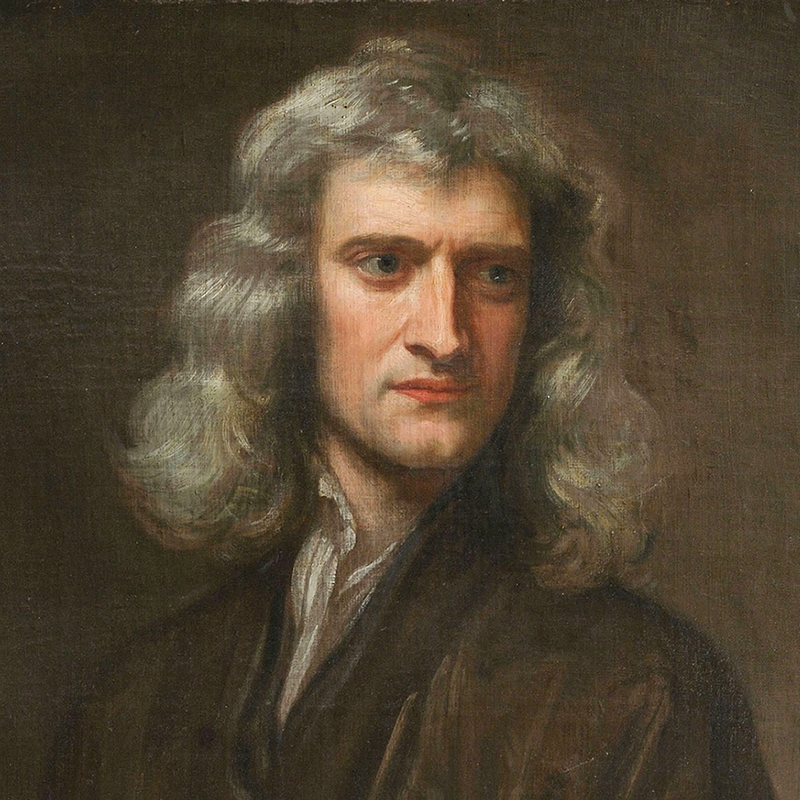
Sir Isaac Newton
- Home
- Resources, Facts & History
- Mathematicians & Scientists
- Sir Isaac Newton
Sir Isaac Newton was a mathematician, physicist, astronomer, theologian and author, known the world over as a key player in the scientific revolution which laid the foundation of classical mechanics.
Key Facts
- Was born Isaac Newton on 4th January 1643 at Woolsthorpe Manor.
- Enrolled at the Trinity College, Cambridge in June 1661.
- Sir Isaac Newton was elected a Fellow of the Royal Society on 11th January 1672.
- Published 'Philosophiæ Naturalis Principia Mathematica', in 1687 which laid the foundation for classical mechanics, revolutionising science by uniting physics with mathematical prediction.
- Elected President of the Royal Society on 30th November 1703.
- Was appointed Warden of The Royal Mint in 1696 on the recommendation of Charles Montagu, who was the Chancellor of the Exchequer at the time.
- Was promoted to Master of The Royal Mint in December 1699.
- Passed away in his sleep in Kensington, London on 31st March 1727 when he was 84 years old.
Early Life & Education
Sir Isaac Newton was born Isaac Newton on 4th January 1643 at Woolsthorpe Manor in Woolsthorpe-by-Colsterworth, located in Lincolnshire, England. Born prematurely, Sir Isaac Newston's father, who also had the name, Isaac Newton, had passed away three months before he was born.
Between the ages of 12 and 17, Sir Isaac Newton attended The King's School, Grantham. During this time, Sir Isaac Newton lived with a local apothecary and began showing a deep interest in mechanical devices, such as sundials and windmills.
At 17, Sir Isaac Newton was taken out of the school by his mother to help manage the family farm but unfortunately, he was a poor farmer and his mother eventually sent him back to The King's School in Grantham to finish his preparation for university.
Sir Isaac Newton enrolled at the Trinity College, Cambridge in June 1661 and initially entered as a 'subsizar', which was a student who was able to pay a lower tuition rate in exchange for completing domestic duties for wealthier students.
While at the Trinity College, where the standard curriculum was based on Aristotle, Sir Isaac Newton studied other, more modern thinkers like René Descartes, Galileo Galilei, and Johannes Kepler. Sir Isaac Newton went on to earn a Bachelor of Arts in 1665 but shortly afterwards, the University at Cambridge closed due to the Great Plague. Because of this, Sir Isaac Newton returned to his home where he stayed from 1665 to 1667, a period which he called his, 'annus mirabilis', or 'year of wonders'. During this period, Sir Isaac Newton completed some of his most notable work and theories on optics, universal gravitation and calculus. Sir Issac Newton returned to Trinity College and where he earned a Master of Arts in 1668.
Academic Career
Upon returning to Cambridge after the Great Plague in 1667, Sir Isaac Newton was elected to become a Minor Fellow of Trinity College. A year later, in 1668, Sir Isaac Newton was elected a Major Fellow after earning his Master of Arts degree.
At just 26 years old, Sir Isaac Newton was appointed to prominent chair of Lucasian Professor of Mathematics in 1669, succeeding his mentor, Isaac Barrow, holding the position for over 30 years until 1701.
Sir Isaac Newton was elected to the Royal Society following the invention of his reflecting telescope 1672, marking his transition into the broader scientific community.
Often called the Principia, Sir Isaac Newton published 'Philosophiæ Naturalis Principia Mathematica' in 1687. Often referred to as the most important work of Sir Isaac Newton, it laid the foundation for classical mechanics with the three Laws of Motion and Law of Universal Gravitation. Made up of three volumes or books, it revolutionised science by uniting physics with mathematical prediction.
The Royal Society
Sir Isaac Newton was elected a Fellow of the Royal Society on 11th January 1672, as a result of his invention of the first functional reflecting telescope, which Sir Isaac Newton had sent to the Royal Society in 1671. Sir Isaac Newton was proposed for candidacy on 21st December 1671, by Seth Ward, the Bishop of Salisbury, being just 29 years old at the time of the election to be a Fellow of the Royal Society.
Shortly after joining, Sir Isaac Newton published his first scientific paper on 8th February 1672 in the Royal Society's journal, Philosophical Transactions, detailing his 'New Theory about Light and Colours'.
Sir Isacc Newton went on to be elected President of the Royal Society on 30th November 1703 and was continually re-elected annually as President for the remainder of his life.
The Royal Mint
Sir Issac Newton moved to London in 1696 when he became Warden of the Royal Mint, continuing to be a Fellow and Professor for Cambridge University until he officially resigned his academic posts in 1701.
Sir Issac Newton was appointed to the post of Warden of the Royal Mint on the recommendation of Charles Montagu, the Chancellor of the Exchequer, during a major monetary crisis known as the Great Recoinage. Although the position was often considered an easy role, Sir Issac Newton took it seriously and played a vital role in the large scale operation of replacing old, clipped coins with new, milled currency to prevent further fraud.
In 1699, Sir Isaac Newton was promoted to the senior role of Master of the Royal Mint in December 1699 and held the position for the rest of his life. In this role, he was responsible for the administration and overall operation of The Royal Mint while transforming its operations and infrastructure, with notable activities and achievements while at The Royal Mint which included:
- Tackling Fraud & Counterfeiting: Dedicated to combating fraud and crime, Sir Isaac Newton personally went undercover, gathered evidence in taverns and prisons and conducted numerous interrogations to prosecute counterfeiters. The efforts led to the conviction and execution of over 28 individuals, including the notorious master forger William Chaloner.
- Precision & Accuracy: Sir Isaac Newton was able to apply his expertise in metallurgy and precision to improve accuracy of weight and fineness in the production of coins. This earned The Royal Mint with a premium reputation for trustworthiness due to the improved quality of monetary standards and reliability of the currency of Great Britain.
- The Gold Standard: In 1717, Sir Isaac Newton issued a now famous report that led to the fixing of the value of the gold guinea coin at 21 shillings. This had the effect of driving silver coinage out of circulation, moving Great Britain onto the gold standard which continued for centuries.
- Consolidation of Mints: Following the Act of Union in 1707, Sir Isaac Newton achieved the challenging process of merging the English and Scottish mints to create a common currency for Great Britain.
Death & Buriel
Sir Isaac Newton was 84 years old, while he was still continuing with his roles at the Royal Society and The Royal Mint, when he passed away in his sleep in Kensington, London on 31st March 1727.
Prior to the funeral, Sir Isaac Newton lay in state in the Jerusalem Chamber of Westminster Abbey for several days. The funeral, which was officiated by the Bishop of Rochester, took place on 4th April 1727 at Westminster Abbey and was buried in the nave, near the choir entrance becoming the first scientist to be buried in Westminster Abbey, marking a significant national tribute and Sir Isaac Newton's status as one of Great Britain's greatest scientists.
A large marble monument designed by William Kent and sculpted by Michael Rysbrack was unveiled near his grave in 1731.