Mary Gillick OBE
- Home
- Resources, Facts & History
- Artists, Engravers & Sculptors
- Mary Gillick OBE
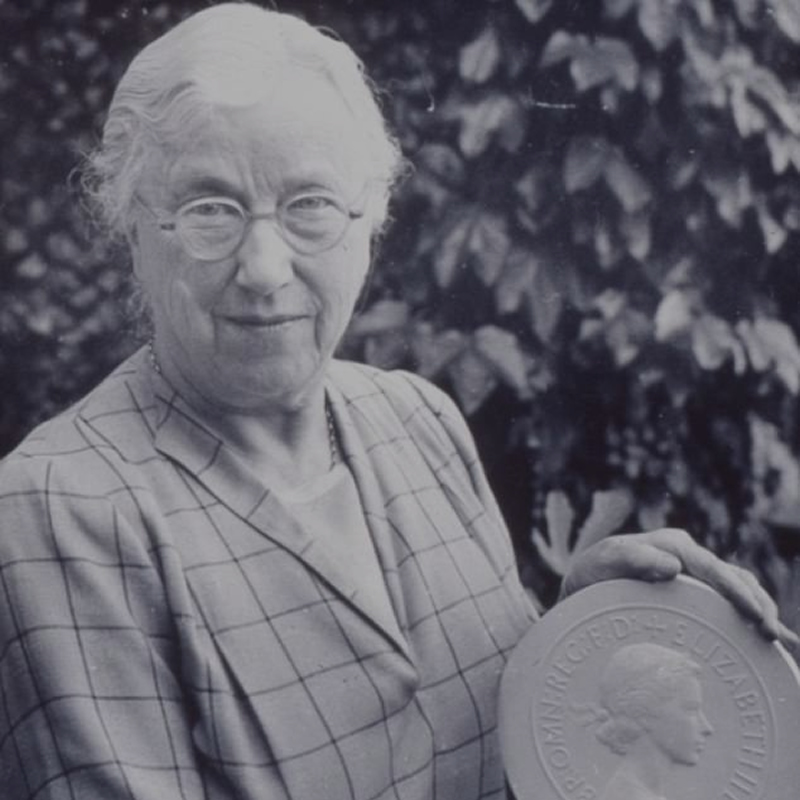
Mary Gillick OBE was a prominent British sculptor and medalist, best known for creating the first definitive coinage portrait of Queen Elizabeth II.
Key Facts
- Born Mary Gaskell Tutin in Nottingham on 4th April 1881.
- Studied at the Nottingham School of Art and the Royal College of Art.
- At the age 71, she won a competition to design the first coin effigy for Queen Elizabeth II.
- Appointed an OBE or 'Officer of the Order of the British Empire', by Queen Elizabeth II, in the 1953 Coronation Honours list.
- Mary Gillick's winning portrait appeared on UK coinage from 1953 to 1971.
- Passed away at the Elizabeth Garrett Anderson Hospital in London on 27th January 1965 at the age of 83.
Early Life & Education
Born Mary Gaskell Tutin on 4th April 1881 in Nottingham, England, she was the daughter of a builder Thomas Tutin and Elizabeth Gaskell Tutin.
In 1890, Mary Gillick attended the Nottingham High School for Girls until 1898, when she enrolled in the Nottingham School of Art. It was during this time that she met her future husband and fellow sculptor, Ernest Gillick.
After graduating from the Nottingham School of Art in 1902, Mary Gillick moved to London to study at the Royal College of Art from 1902 to 1904. While at the college, Mary Gillick was a scholar under the renowned French sculptor Édouard Lantéri, who significantly influenced her medallic work.
Shortly after graduating from the Royal College of Art, Mary Gillick married Ernest Gillick in 1905. Famously described as an 'ideal working partnership', they frequently collaborated on artistic projects from their home and studio in Chelsea.
The First Portrait of Queen Elizabeth II
In 1952 at the age 71, Mary Gillick won a competition to design the new portrait for Queen Elizabeth II that would be used for UK coinage. For the competition, the Royal Mint Advisory Committee considered nearly 300 submissions and played a crucial role in selecting the winning design.
Prince Philip, Duke of Edinburgh, as president of the RMAC, oversaw the process and provided guidance on selecting the winning portrait, which depicted a youthful Queen Elizabeth II wearing a laurel wreath instead of a crown, a detail that stood out to the committee.
The portrait design for Queen Elizabeth II, created by Mary Gillick, appeared on all UK and Commonwealth coinage from 1953 until decimalisation in 1971. While later portraits by other artists were introduced for circulating coins, the first effigy of Queen Elizabeth II by Mary Gillick was still used on Maundy money and appeared on British commemorative stamps up until 2023.
Sculptures, Memorials & Medallic Art
While being famously known for her 1952 portrait of Queen Elizabeth II, Mary Gillick’s career spanned over 50 years, with work and projects ranging from tiny coins to large-scale stone memorials.
Mary Gillick created some commemorative coins during her career, such as the obverse of the 1960 New York Exhibition Crown. Mary Gillick also designed the reverse of the 1965 Sir Winston Churchill Crown, released to mark the death of the former Prime Minister.
A prolific medalist, Mary Gillick create many medals and awards which included:
- Prize Medals: Designed prize medals for the Royal Society, the Royal Academy Schools and the Institute of Physics.
- Suffragette Portrait: Created a portrait medal of the prominent suffragette and novelist, Ida Wylie, which was commissioned by Ida Wylie's partner, Rachel Barrett.
- Society of Chemical Industry: Produced various bronze medals and plaques for the society in 1931.
- Korea War Medal: Created the obverse effigy in 1951, which was used for service medals that were awarded during the Korean War.
- Prince Philip Portrait: Commissioned to design a portrait medal of the Duke of Edinburgh for organisations under his stewardship.
Alongside her medallic work, Mary Gillick also specialised in sculptures and memorials in stone and bronze. Notable work included:
- Kathleen Ferrier Memorial: Designed a bronze relief portrait memorial, celebrating the English singer, which was unveiled in 1958 at the University College Hospital, London.
- Sir William Bragg: Unveiled in 1943, Mary Gillick created a bronze memorial plaque for the Nobel Prize-winning physicist, Sir William Henry Bragg, at the Royal Institution in London.
- Adam and Eve Sculptures: Sculptures made from lead, which were titled 'Adam', and 'Eve', were exhibited at the Royal Academy in the 1930's.
- Sir Henry Wellcome: A circular bronze portrait created in 1953 for the Wellcome Foundation, currently located at the Leeds Art Gallery, Leeds Museums and Galleries.
- Sir Henry Dale: A bronze plaque created in 1955 for the Royal Society of Medicine to commemorate the English pharmacologist and physiologist.
- Bishop George Bell Memorial: A significant memorial which is located in Chichester Cathedral.
- Chelsea Old Church Monuments: In 1935, Mary Gillick carved a memorial in memory of notable women from Chelsea which included Margaret Roper, Magdalen Herbert, Mary Astell, and Elizabeth Blackwell.
Awards
Mary Gillick was appointed an OBE or 'Officer of the Order of the British Empire', in the 1953 Coronation Honours list.
Following her monumental achievement in 1952 when her design was selected for the official coinage portrait of Queen Elizabeth II, the official announcement of Mary Gillick's OBE coincided with the historic coronation of Queen Elizabeth II on 2nd June 1953, the very same year the iconic effigy first entered circulation.
Death & Legacy
Mary Gillick passed away at the Elizabeth Garrett Anderson Hospital in London on 27th January 1965 at the age of 83. After battling severe arthritis in her final years, Mary Gillick remained active in her artistic career for as long as she was physically able.
The specific records detailing Mary Gillick's exact funeral date, service and burial or cremation location were handled privately while Mary Gillick's obituary was published in The Times newspaper on 1st February 1965.
Mary Gillick's death marked the immediate end of the tenancy at her beloved home and workspace, The Manse at Moravian Close in Chelsea, which was returned to the Fetter Lane Congregation.
Mary Gillick didn't have any children of her own but following the death of her niece in 2004, the family donated a significant collection of her medals, plaster models and documents to the British Museum and the Henry Moore Institute, while her artistic legacy continued through later generations, with artists such as her nephew, James Gillick and grand-nephew, Liam Gillick.