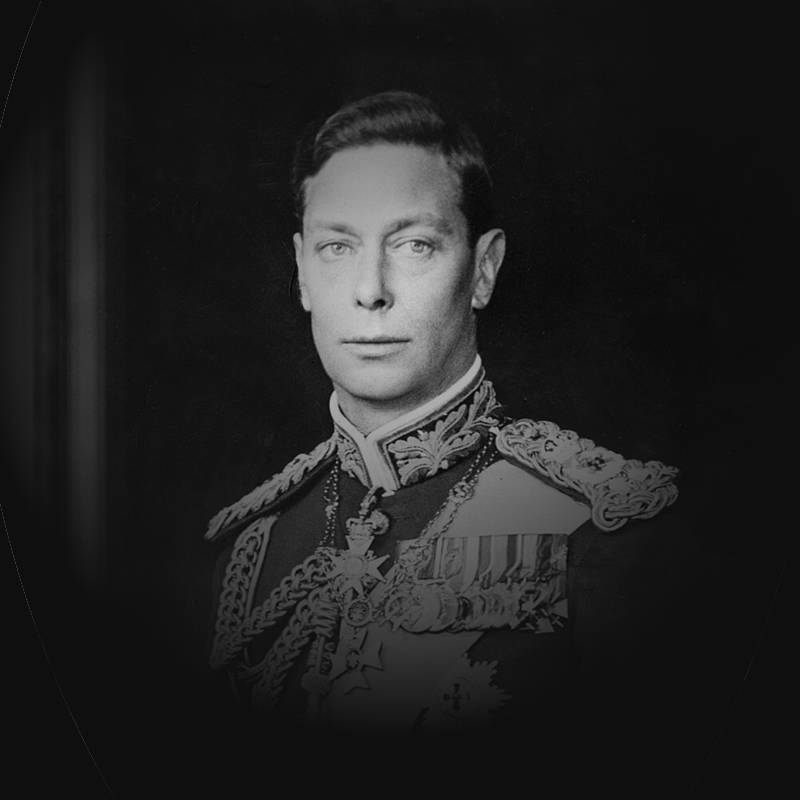
King George VI
King George VI, the second son of King George V and Queen Mary, was King of the United Kingdom and Commonwealth from 11th December 1952 until his death on 6th February 1952.
Key Facts
- Born Albert Frederick Arthur George on 14th December 1895.
- Was the second eldest son of King George V.
- Served in World War I in the Royal Navy and Royal Air Force, famously taking part in the Battle of Jutland in 1916, the largest naval battle of the war.
- Prince Albert, Duke of York married Lady Elizabeth Bowes-Lyon in Westminster Abbey on 26th April 1923.
- Succeeded his older brother, King Edward VIII, after he abdicated from the throne on 10th December 1936.
- Albert Frederick Arthur George, who had the title Prince Albert, Duke of York, legally became King George VI on 11th December 1936.
- The coronation of King George VI and his wife, Queen Elizabeth took place at Westminster Abbey on 12th May 1937.
- Was the reigning monarch during World War II.
- King George VI reigned for 15 years and 58 days.
- Died on 6th February 1952 at the age of 56 at Sandringham House.
- Succeeded by his eldest daughter Queen Elizabeth II.
Early Life
Born Albert Frederick Arthur George on 14th December 1895 at York Cottage on the Sandringham Estate in Norfolk. The second son of King George V and Mary of Teck, also known as Queen Mary, his birth occurred on the 34th anniversary of the death of his great-grandfather, Prince Albert, the husband of Queen Victoria. Because of this coincidence, he was named Albert to please the mourning great-grandmother, being known informally as 'Bertie', within the royal family.
Given the title 'His Highness Prince Albert of York', shortly after his birth, he was raised in a strict and formal environment. The young prince also suffered from health issues such as chronic stomach pain and 'knock knees', medically known as 'genu valgum', being made to wear corrective metal splints which were painful.
From a young age, King George VI developed a severe stammer which has been atributed to his strick upbringing, some of which was the responsibility of nannies, who were reportedly neglectful and even abusive.
When Queen Victoria passed away on 22nd January 1901, the title for King George VI was changed to 'His Royal Highness Prince Albert of Wales', when his grand father, King Edward VII, ascended to the throne.
Naval Education
At 13 years of age, King George VI started his education in January 1909 at the Royal Naval College in Osborne. During this time, King George VI's official title was changed on 6th May 1910 to 'His Royal Highness The Prince Albert', following his father's accession to the throne as King George V.
In January 1911, he progressed onto the senior Royal Naval College in Dartmouth and was known to struggle academically, notoriously finishing at the bottom of his class in final exams.
However, King George VI would later be commissioned as a midshipman in September 1913, officially beginning his service in the Royal Navy.
Military Service
King George VI was commissioned as a midshipman in 1913 and would go on to serve in World War I. During this time, King George VI was serving on HMS Collingwood during the Battle of Jutland in 1916, the largest naval battle of the war, being mentioned in despatches on his conduct during the battle as a turret officer.
However, ongoing sea sickness and other health issues, including an ulcer would eventually make King George VI unfit to continue his service at sea, being transferred to the Royal Naval Air Service in early 1918. Shortly afterwards, when the Royal Air Force was established on 1st April 1918, King George VI was transferred to the new branch, becoming the first member of the Royal Family to become a fully qualified pilot on 31st July 1919.
During the final weeks of World War I, King George VI would serve on the staff of General Hugh Trenchard on the European front in France.
Marriage
King George VI first met Elizabeth Bowes-Lyon, a descendant of Scottish nobility, at a children's party in 1905, meeting again as adults in 1920.
In the same year, on 3rd June 1920, King George VI's father, George V, gave him the titles of Duke of York, Earl of Inverness and Baron Killarney.
Hesitant to join the royal family, fearing her loss of personal freedom, Elizabeth turned down the first marriage proposal from King George VI in 1921, only to refuse a second marriage proposal from King George VI when he proposed again in 1922.
Elizabeth finally accepted the third marriage proposal in January of 1923, after continued persistence from King George VI and were married just a few months later on 26th April 1923 in Westminster Abbey.
Accession To The Throne
When King George VI's father, King George V passed away on 20th January 1936, his older brother, Edward Prince of Wales became King Edward VIII.
However, at the same time, King Edward VIII was determined to be married to twice-divorced American socialite, Wallis Simpson. This caused a constitutional crisis within the British Government as well as a religious conflict in the Church of England.
Deciding to abdicate, King Edward VIII signed the 'Instrument of Abdication' on 10th December 1936, with the abdication officially taking legal effect on 11th December 1936.
Following the abdication, Prince Albert, Duke of York, legally became King George VI on 11th December 1936, formally being proclaimed king by the Accession Council at St. James's Palace on 12th December 1936.
Coronation
The coronation of King George VI and his wife, Queen Elizabeth took place at Westminster Abbey on 12th May 1937. The coronation date was the same originally planned for the ceremony of King George VI's older brother King Edward VIII, before his abdication, who at the time of the coronation was recognised as Prince Edward, Duke of Windsor.
The coronation ceremony was conducted by Archbishop Cosmo Lang, who presided over the taking of the oath and crowning of King George VI with St. Edward's Crown. Attended by around 8,000 guests from around the world who filled Westminster Abbey, one of whom was King George VI's mother, Queen Mary. This was the first time in history when the widow of the previous king, known as a British Dowager Queen, attended a coronation ceremony.
The coronation was a landmark broadcast for the British Broadcasting Corporation or BBC, being the first corontation ceremony to be broadcast live on radio and television. The coronation ceremony was filmed, with the live television broadcast only being permitted to broadcast the procession, the first live television broadcast filmed outdoors.
Reign
King George VI was 41 years old when he was coronated to officially become the Head of State for the United Kingdom, head of the Church of England, and head of the UK armed forces.
During his reign, King George VI primarily focused on providing moral leadership during World War II, choosing to stay in the UK, defying advice to evacuate to Canada and continued to remain at Buckingham Palace in London throughout The Blitz.
While providing his full support to the Prime Minster, Sir Winston Churchill, King George VI continued to make foreign visits during World War II, visiting troops abroad in France, United States and Canada in 1939, North Africa and Malta in 1943 and Normandy shortly after the D-Day landings in 1944.
In 1940, King George VI established the Bravery Awards, instituting the George Cross and the George Medal, recognising the need to award civilian bravery for acts of conspicuous courage. In 1943, the entire island of Malta was awarded the George Cross for their resistance during the Siege of Malta from June 1940 to November 1942.
King George VI's reign was also marked by the accelerating dissolution and decline of the British Empire, marked by landmark events such as Burma, India and Pakistan gaining independence in 1947.
However, it would also see the rise of the Commonwealth of Nations which was a new association of equal and free nations, some of which would continue to keep the British monarchy as their head of state. In 1949 with what is known as the London Declaration, King George VI was recognised as the first official Head of the Commonwealth, giving the British monarchy renewed purpose in a changing world.
During his time, King George VI would learn to manage his stammer to deliver ongoing radio addresses across the globe, providing millions of people worldwide with direct access to the monarchy.
Death & Funeral of King George VI
King George VI reigned for 15 years and 58 days, passing away on 6th February 1952, due to a coronary thrombosis at the age of 56 in his sleep at Sandringham House, the Royal Family's private estate in Norfolk, England.
At the time of his death, King George VI was supposed to be on a Commonwealth tour but due to poor health, his eldest daughter, Princess Elizabeth had taken his place. Princess Elizabeth, who became Queen Elizabeth II when her father King George VI died, was on the Commonwealth tour in Kenya with her husband, Prince Philip.
In 1952 King George VI was planning a tour of the Commonwealth but due to poor health, Princess Elizabeth who was accompanied by Prince Philip, took his place. On 6th February 1952 while in Kenya, the first country of the tour, at the age of 25, Elizabeth Alexandra Mary became Queen Elizabeth II once she learned of the death of her father King George VI.
From 8th February to 11 February 1952, King George VI lay in state at St. Mary Magdalene Church, Sandringham with staff from the Sandringham estate, including gamekeepers and foresters, keeping a continuous vigil around his coffin.
King George VI was then taken to London by the Royal Funeral Train for a formal state lying in state in Westminster Hall, which took place from 11th February to 15th February 1952. Draped in the Royal Standard and topped with the Imperial State Crown, the Orb, and the Sceptre, the coffin of King George VI was guarded around the clock by officers from the Household Troops, the Yeomen of the Guard, and the Gentlemen-at-Arms. While at Westminster Hall, over 300,000 mourners filed past the coffin of King George VI to pay their respects, with the queue stretching up to four miles long at its peak.
The state funeral of King George VI took place on 15th February 1952, starting at 9:30am with a mile long funeral procession starting from Westminster Hall. During the day, Big Ben tolled 56 times, once for each year of the life King George VI, the United Kingdom and the Commonwealth observed two minutes of silence at 2:00pm and a 56-gun salute was fired in Hyde Park and Tower of London.
The first state funeral of a British monarch to be broadcast on television, the procession ended at Paddington Station where the coffin of King George VI was loaded onto the Royal Train for the journey to Windsor.
A final service was held by the Archbishops of Canterbury and York at St George’s Chapel in Windsor Castle where Sir Winston Churchill laid a wreath with a card that read 'For Valour'.
King George VI was initially placed into the Royal Vault of St George's Chapel but was moved to a newly built King George VI Memorial Chapel in 1969.