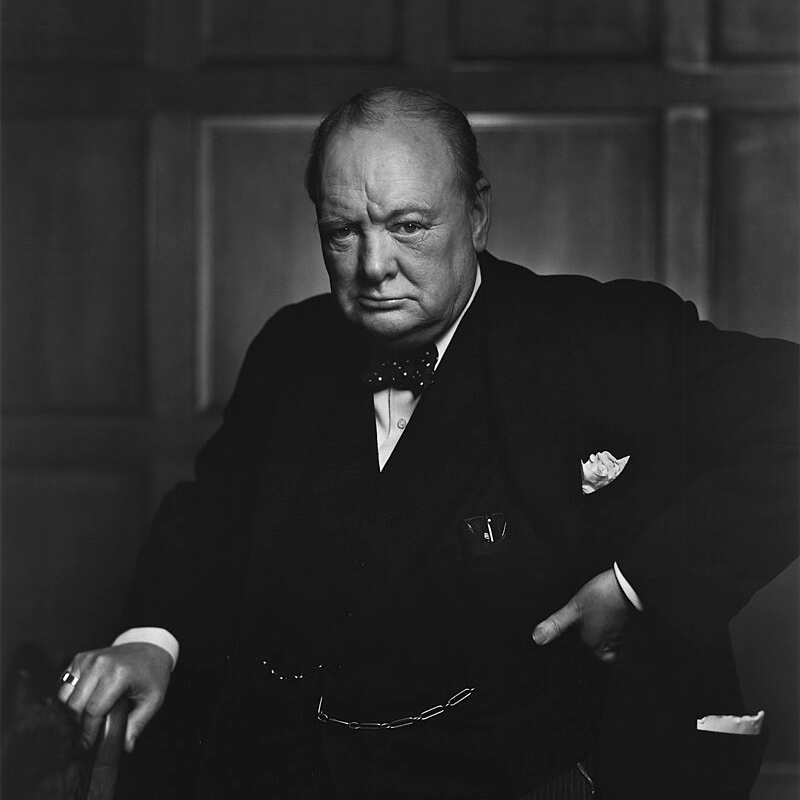
Sir Winston Churchill
Sir Winston Churchill was a British statesman, military officer and writer who was Prime Minister of the United Kingdom from 1940 to 1945 during World War II and again from 1951 to 1955.
- Home
- Resources, Facts & History
- Politicians, Monarchies & Military Leaders
- Sir Winston Churchill
Key Facts
- Was born Winston Leonard Spencer Churchill at his family's ancestral home, Blenheim Palace in Oxfordshire on 30th November 1874.
- Was commissioned in February 1895 as a second lieutenant in the 4th Queen's Own Hussars regiment of the British Army.
- Was First Lord of the Admiralty before and during World War I.
- Became Prime Minister of the United Kingdom from 1940 to 1945, serving under King George VI during World War II.
- Was Prime Minister for a second time of the United Kingdom in 1951, eventually serving under Queen Elizabeth II until April 1955.
- He was awarded the Nobel Prize in Literature in 1953.
- In 1963, United States President John F. Kennedy, made him an honorary citizen of the United States.
- Passed on the 24th January 1965 in his home at 28 Hyde Park Gate, London, at the age of 90.
Early Life & Education
Winston Leonard Spencer Churchill was of mixed English and American parentage who was born into the wealthy, aristocratic Spencer family on the 30th November 1874 at his family's ancestral home, Blenheim Palace in Oxfordshire.
The eldest Son of Lord Randolph Churchill and Lady Jennie Churchill, he was reportedly born two months premature. Shortly afterwards, John Spencer-Churchill, the 7th Duke of Marlborough was appointed Viceroy of Ireland from 11 December 1876 and with Lord Randolph Churchill as his private secretary, resulted in the Churchill family relocating to Dublin until May 1880.
In 1882, aged seven, Winston Churchill began boarding at St. George's School in Ascot, Berkshire and in September 1884, because of poor health, he moved to Brunswick School in Hove. In 1888, Winston Churchill narrowly passed the entrance exam to become a pupil at Harrow School.
Military Career
In September 1893, Winston Churchill was accepted as a cadet at the Royal Military Academy in Sandhurst to become an officer in the cavalry. After two previous failed attempts to be accepted at the Acadamy, Winston Churchill spent 15 months at Sandhurst graduating in December 1894.
Shortly afterwards in February 1895, Winston Churchill was commissioned in the British Army as a second lieutenant with the 4th Queen's Own Hussars regiment who were based at Aldershot. Starting a varied military career, he was keen to witness military action, travelling to Cuba in the Autuumn of 1895 to observe the War of Independance which was taking place at the time. While in Cuba, Winston Churchill was involved in several clashes against independance fighters while fighting alongside Spanish troops.
Winston Churchill later travelled to Bombay in British India in October 1896, serving with the Hussars as a young officer and was involved in military campaigns across British India, the Mahdist War and the Second Boer War. Winston Churchill also gained fame from being a war correspondant, writing various books and escaping as a prisoner of war after being captured by the Boer authorities.
Winston Churchill later served in World War I as the First Lord of the Admiralty and oversaw the catastrophic Dardanelles and Gallipoli campaigns, being demoted to Chancellor of the Duchy of Lancaster. Winston Churchill later demoted himself to serve as a lieutenant colonel commanding an infantry battalion, the Royal Scots Fusiliers, fighting in the trenches of the western front from 1915 to 1916.
In 1917, he returned to government under David Lloyd George and served successively as Minister of Munitions, Secretary of State for War, Secretary of State for Air and Secretary of State for the Colonies, overseeing the Anglo-Irish Treaty and British foreign policy in the Middle East.
Political Career
Winston Churchill's political career began when he was elected to take the seat for Oldham as Member of Parliament or MP in the House of Commons in October 1900. He spent a total of 55 years as a Member of Parliament where he also served areas of Manchester Northwest from 1906 to 1908, Dundee from 1908 to 1922 and Woodford from 1924 to 1964.
Between 1906 and 1940, Churchill served in the British Cabinet in charge of Board and Trade, Home Office, Admiralty, Munitions, War and Air Ministries. A position which was once held by his father Lord Randolph Churchill, he headed the Treasury as Chancellor of the Exchequer From 1924 to 1929.
Neville Chamberlain resigned as Prime Minster in 1940 due to a loss of confidence from his party following the failure of the Allied campaign in Norway as World War II was breaking out. Because of this, Winston Churchill was chosen to succeed him as Prime Minister of an all-party coalition government.
He later wrote, "I felt as if I were walking with Destiny, and that all my past life had been but a preparation for this hour and for this trial". Developing an alliance with Russia and America, he became a symbol for victory. In 1945, with the war in Europe over but the war with Japan still being fought, the Labour party defeated the Conservatives in an election. Churchill was no longer Prime Minister but was reelected to his seat and became Leader of the Opposition.
Winston Churchill was successfully relected in 1951 and became Prime Minsiter of the United Kingdom for a second time. During his premiership, was knighted as a Knight of the Garter in 1953 by Queen Elizabeth II and was the first person to be appointed to this honor by the new Queen in recognition of his leadership during World War II. However, due to poor health, Sir Winston Churchill resifgned as Prime Minster in 1955.
He continued to be a Member of Parliament after his second term as Prime Minster, representing Woodford until he stood down in the 1964 general election.
Death & Funeral
After suffering a stroke on 10th January 1965, Sir Winston Churchill died at his London home, 28 Hyde Park Gate at the age of 90 on 24th January 1965.
He was given a state funeral where his coffin lay in state at Westminster Hall for three days. After the funeral ceremony took place at St Paul's Cathedral on 30th January, the coffin was taken by boat along the River Thames to Waterloo Station where the coffin was taken by train to the family plot at St Martin's Church, Bladon.